
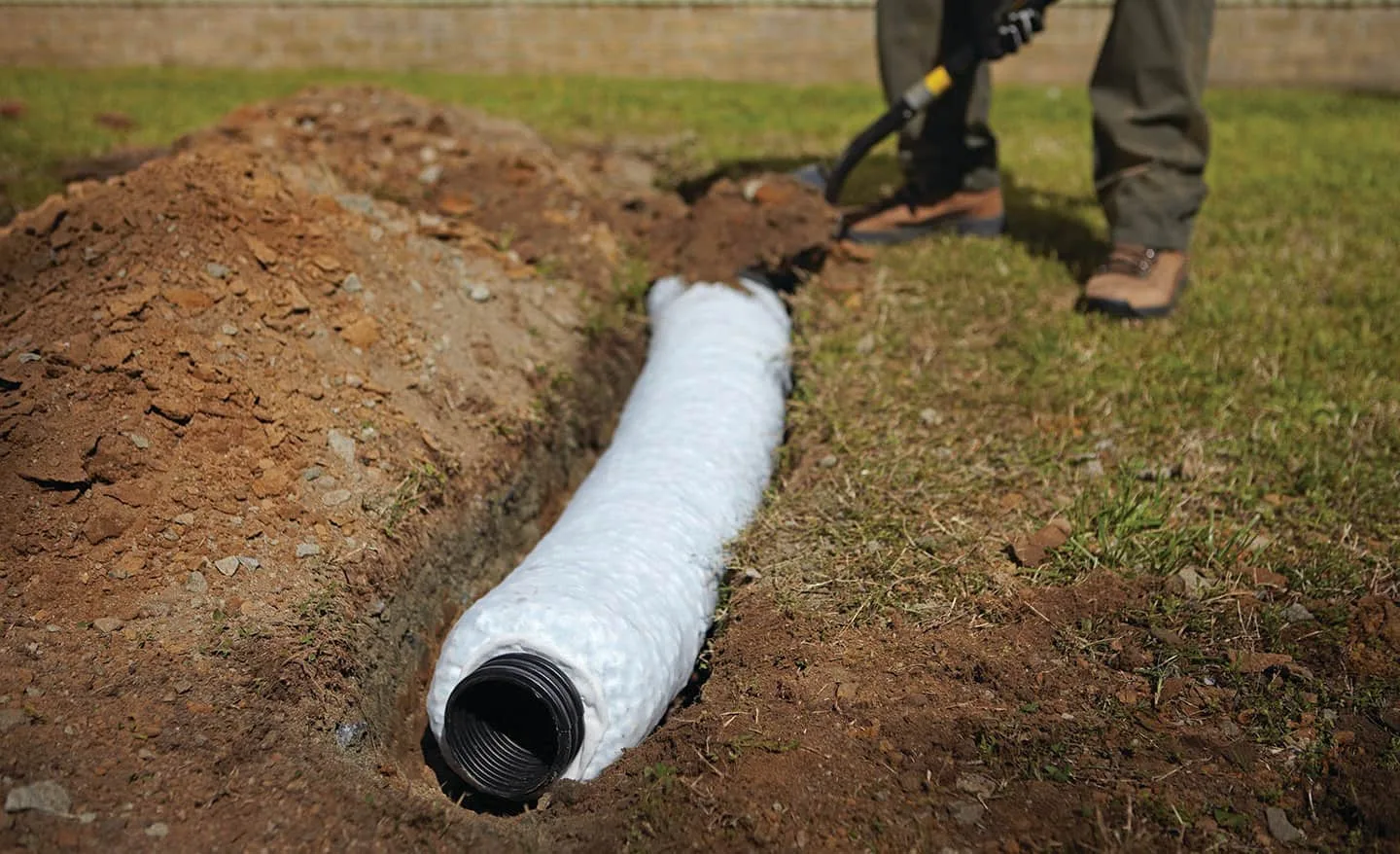
How much does a french drain cost in the Northshore area?
Nationally, an exterior french drain runs about $10 to $75 per linear foot installed, and most yard projects land between $2,800 and $6,500. Interior perimeter systems cost more, $40 to $100 per foot. No major cost guide publishes a Louisiana-specific number, so treat those national ranges as the honest baseline and expect your exact price to come from the lot itself.
That last part matters more here than most places. Around Covington, Mandeville, and the rest of St. Tammany Parish, the ground is flat, the rain is heavy, and the winter water table rides high. All three change how a drain gets designed, and the design is what sets the price.
What a french drain costs by type
| Type | Typical installed cost | Notes |
|---|---|---|
| Curtain drain (shallow) | $10–$25 per linear foot | Intercepts surface and shallow water |
| Exterior yard drain | $10–$75 per linear foot | The common backyard fix; most projects $2,800–$6,500 |
| Exterior around the foundation | $10–$50 per linear foot | Roughly $500–$10,000 per project |
| Interior basement perimeter | $40–$100 per linear foot | $5,000–$18,000; involves breaking concrete |
Those figures come from the major national cost guides, HomeAdvisor, Bob Vila, LawnStarter, and Lawn Love, all current within the last two years. They agree on the shape of the market even where the exact numbers differ. Since south Louisiana homes skip basements, almost all Northshore work is the exterior kind, which is the cheaper half of the table.
What drives the price up or down
Five things move the number more than anything else:
- Length. Drains price by the foot, so a 40-foot problem costs a fraction of a 150-foot one.
- Depth. A shallow curtain drain is quick work. A deep drain protecting a slab takes more digging, more gravel, and more pipe.
- Soil. Clay digs slow and holds water. Labor rates of $50 to $100 per hour per worker add up faster in heavy ground.
- The outlet. Water has to go somewhere legal. Daylighting to a ditch or swale is baseline. When gravity will not carry it, a sump pump adds roughly $500 to $2,600.
- Permits and restoration. Permits generally run $50 to $225 where required, and re-sodding the scar costs about $0.90 to $1.80 per square foot.
One Northshore-specific driver deserves its own line: the outfall. St. Tammany’s own hazard planning describes flat terrain where ponding collects in clay-lined low areas that cannot drain. If your lot has no natural fall, getting water to a ditch or street legally is the design problem, and solving it is where the money goes.
Why the Northshore water table changes the design
On the parish’s terrace soils, the seasonal water table sits about 1 to 3 feet below the surface from December through April. A standard 18-to-24-inch drain spends part of the winter sitting in groundwater, which means it will run almost constantly in the wet months. That is fine, that is the job, but only if the drain has a genuine gravity outfall. A drain that dead-ends into a gravel pit expecting the soil to absorb water will fail here, because in January the soil is already full.
Add the rain math and the picture is complete: Slidell averages 66 inches a year, Hammond 64, and southeast Louisiana overall runs among the wettest regions in the country, with 4-inch rain days hitting record frequency in recent years. A drain built for Atlanta conditions is undersized for ours. This is why we design the outfall first and the trench second on every drainage project we build.
Cheaper fixes worth pricing first
A french drain is the right tool for subsurface water. If your problem is surface water, one of these may solve it for less:
| Fix | Typical cost | Best for |
|---|---|---|
| Downspout extensions | Minimal | Roof water dumping at the slab |
| Regrading | $500–$4,000 | Yards pitched toward the house |
| Catch basin | $20–$130 per basin plus piping | Collecting water at a low point |
| Dry well | $500–$3,000 | End-of-line storage, where soil allows |
| Sump pump | $500–$2,600 | Water with nowhere to gravity-drain |
Around here, regrading and french drains often work as one project, shape the yard to move surface water, and let the drain handle what soaks in. Since we do our own grading and dirt work, we quote it as one scope with one crew, which usually beats hiring the fixes separately.
Getting a real number for your yard
The honest answer to “what will mine cost” is a walk around your lot: where the water stands, where it can exit, how deep the trench needs to run, and what the soil is doing. That takes about twenty minutes and costs nothing. If the yard has been a swamp since Christmas, that is normal for this parish, and it is fixable. Reach out for a free estimate and we will design the drain around how your ground actually behaves.