Why does concrete crack on Louisiana clay, and what does a proper pour do differently?
South Louisiana ground moves. Clay-heavy soil swells when it rains and shrinks when it bakes, the water table sits a few feet down all winter, and parts of the metro are slowly sinking. Concrete poured straight onto ground like that settles, heaves, and cracks. A proper pour changes the ground first: strip the topsoil, build a compacted gravel base, move the water away, set the steel where it works, and cut joints before the slab picks its own crack lines.
What is the ground here, actually?
It depends which side of the lake you are on. Around Covington and the Northshore, the USDA soil survey maps mostly silt loams over slow-draining subsoil. The seasonal water table sits 1 to 3 feet below the surface from December through April, and the survey rates the subsoil’s shrink-swell as moderate. Its guidance for these soils is blunt: roads and foundations need drainage, and designs have to withstand the shrinking and swelling.
South and across Lake Pontchartrain, it gets heavier. The delta clays that people call gumbo run 60 to 90% clay and crack open 1 to 3 centimeters wide in a dry spell, down to 2 feet deep. That movement is expensive statewide. A Louisiana study put expansive-soil property losses at $66 million a year, with cracked driveways, slabs, and foundations leading the damage list, and it projects the single worst census block in the state for future losses sits right here in St. Tammany Parish. Parts of the New Orleans metro also subside, most of it stable but with pockets sinking an inch or more a year.
None of that makes concrete a bad idea here. It makes preparation the job.
Why slabs crack on clay
Concrete is strong in compression and weak in tension. It cracks when the ground stops supporting it evenly, and clay is good at exactly that.
- Clay is weak. High-clay subgrade offers about one quarter of the support stiffness of a compacted gravel base.
- Clay moves. Wet years heave it, droughts shrink it, and the slab bridges gaps until it breaks. Big trees make it worse by drying the clay under one edge.
- Water works from below. A high water table softens the subgrade and wicks moisture up into the slab.
- Soft spots settle. Unstripped topsoil, buried debris, and loose fill compress under load.
One more piece of honesty from the industry itself: a crack-free slab is not a realistic promise. The American Concrete Institute treats visible random cracking in up to 3% of a floor’s panels as normal. The goal is a slab where the cracks land in the joints you cut, stay hairline, and never become trip hazards.
What a proper pour does differently
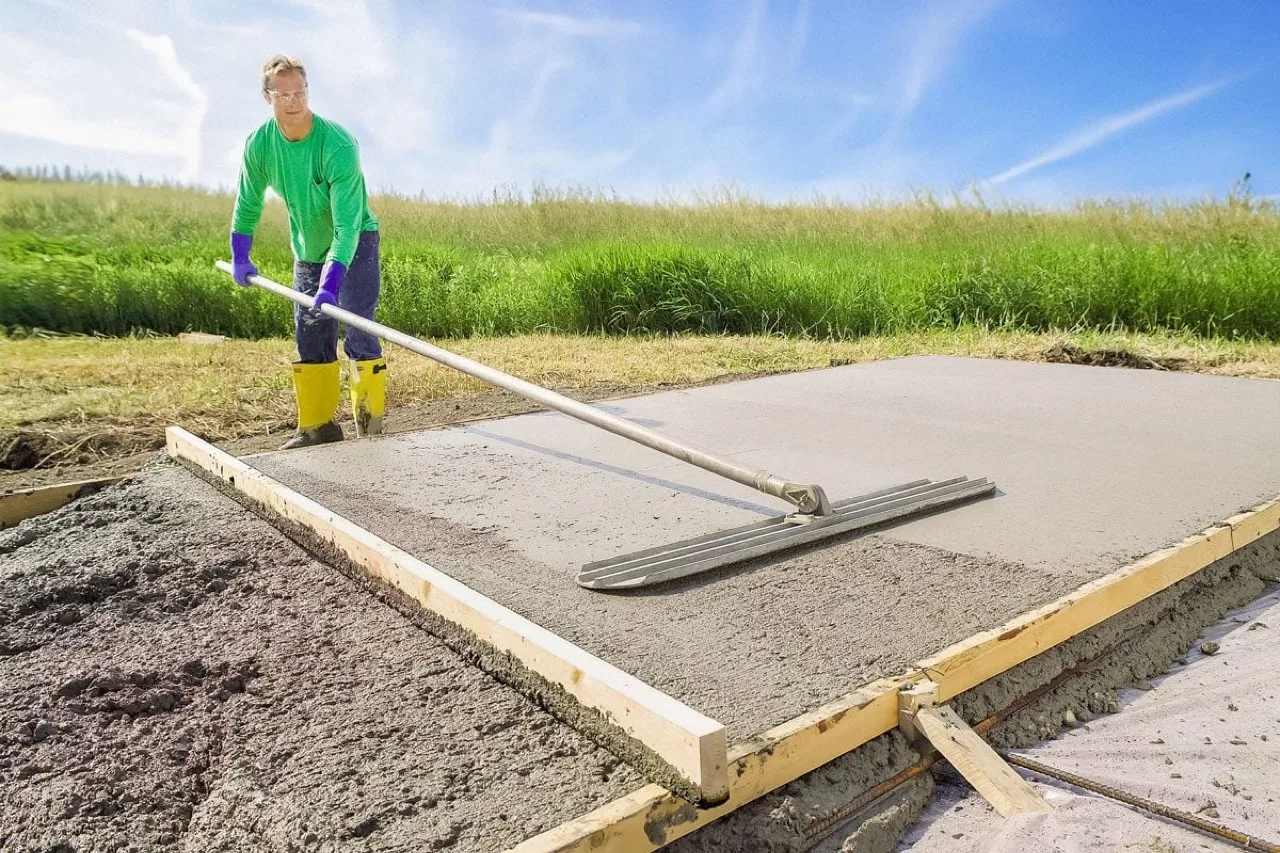
Here is the checklist that matters on this ground, and what each line is for.
| Step | The spec | What it prevents |
|---|---|---|
| Strip the surface | All vegetation, topsoil, organics off | Soft spots that settle |
| Base course | 4 in. minimum gravel or crushed stone, 2–8 in. on expansive clay | Uneven support, wicking |
| Compaction | 95% density, thin lifts | Settlement cracking |
| Drainage | Ground falls 6 in. in the first 10 ft; drains where water collects | Water under the slab |
| Vapor retarder | 10-mil sheet under enclosed slabs | Slab moisture problems |
| Steel | Mesh or rebar on chairs, upper half of the slab | Wide, working cracks |
| Joints | Cut at 8–12 ft for a 4-in. slab, a quarter of the depth | Random crack lines |
| Cure | Keep it moist 3 to 7 days | Weak, dusting surface |
The base is the heart of it. On fine-grained soil like ours, the gravel layer is also a capillary break: it stops ground moisture from climbing into the concrete. On lots where water stands, the fix belongs to drainage and site work before any concrete is scheduled, and the finished grade around a house has to fall away from it. That is codified here: 6 inches of fall in the first 10 feet, and paved surfaces near the foundation sloped at least 2%.
On the worst ground, the answer escalates past flatwork. Louisiana’s residential code sends expansive-soil foundations to engineered design, and post-tensioned slabs exist for exactly this soil. If a grading and dirt work crew tells you your site needs engineered fill or a thicker section, that is the ground talking, not the salesman.
Does rebar stop cracks?
No, and it is worth knowing why before you compare bids. Reinforcement does not prevent cracking. The ready-mix industry’s own technical bulletin says wire mesh “will not prevent cracking.” What steel does is control crack width. It holds the two sides of a crack together so the slab keeps acting like one piece instead of separate plates.
Placement decides whether you got what you paid for. Steel only works up in the slab, and code requires it supported from the center to the upper third of the pour. Mesh laid flat on the dirt and tugged up by a rake usually sinks back to the bottom, where it does nothing. Chairs are cheap. Fibers in the mix help with early shrinkage cracks, but the industry bulletins are direct that fibers do not replace structural steel and do not let anyone pour thinner or space joints wider.
When should you not pour?
Cold is the easy answer and rarely ours: below 40 degrees, hydration nearly stops, and nobody pours on frozen ground. Around here maybe five nights a year qualify.
Heat is the real Louisiana constraint. At 50 degrees, concrete takes about 12 hours to reach initial set. At 100 degrees, about 3. Hot mixes demand more water, and water added at the truck to keep it workable costs strength. Dry wind pulls moisture off the surface faster than the slab bleeds, which is where plastic shrinkage cracks come from. The first day matters most: concrete that spends its first 24 hours near 100 degrees gives up 10 to 15% of its 28-day strength.
A summer pour here is a timing exercise. Early placement, damp subgrade, no water sprinkled on the surface to help finishing, joints cut within 6 to 12 hours, and curing started immediately. Curing is the cheapest strength there is: a slab kept moist for a week ends up dramatically stronger than one left to bake, and the humid Gulf air helps but does not do the job alone.
What happens if you skip the gravel?
Everything above, at once. The slab sits on soil that is four times softer than a base course. Ground moisture wicks straight up, which shows up later as dark slabs, failing coatings, and efflorescence. Soft spots settle and the slab cracks across the middle instead of at the joints. And where the slab sits below grade, a base course is not optional anyway: the residential code requires 4 inches of it on any soil that is not clean sand or gravel.
Some people try to skip the concrete instead, with the compacted crushed-limestone approach that gets called poor man’s concrete. It has real uses, and it fails predictably under wheels: the guides that describe it say plainly that it shifts under heavier vehicles, ruts, and needs constant topping up. It is a path material. A slab it is not.
FAQ
Can you pour concrete directly on clay soil? Not if you want it to last. Clay gives about a quarter of the support of a compacted gravel base, holds water against the slab, and moves as it wets and dries. The USDA’s own guidance for this parish’s soils says foundations need drainage and designs that handle shrink-swell.
What happens if you pour concrete without gravel under it? Three things go wrong. The slab loses its capillary break, so ground moisture wicks up into the concrete. It loses uniform support, the main cause of random cracking. And on soft spots it settles unevenly. Code also requires a 4-inch base course wherever the soil is not clean sand or gravel.
When should you not pour concrete? Below 40 degrees, on frozen or saturated ground, and in hot, windy, dry conditions without precautions. Heat is the Louisiana risk: at 100 degrees concrete sets in about 3 hours instead of 12, and a slab that dries too fast cracks early and cures weak.
Does rebar stop concrete from cracking? No. Reinforcement controls how wide cracks open; it does not prevent them. The ready-mix industry’s own bulletin says wire mesh will not prevent cracking. Steel keeps cracks tight and the slab locked together, and it only works when it is supported up in the slab, not lying on the dirt.
What is poor man’s concrete? Usually dry cement raked over gravel and misted with water, sometimes compacted crushed limestone on its own. The guides that describe it warn it cracks and cannot carry a vehicle. There is no controlled mix, no steel, and no compacted base, so it is a path material, not a slab.
Start with the ground, then pour
The slab you see is the cheap part. What decides its life is the dirt work, the base, the water, and the first week of curing. W2 Commercial Construction handles the whole chain, site prep and drainage through finished concrete, across the Northshore and Greater New Orleans. If your lot holds water or your last slab cracked early, ask for a free estimate and we will figure out what the ground needs before anyone orders a truck. For prices by project, see what concrete costs in our area.