
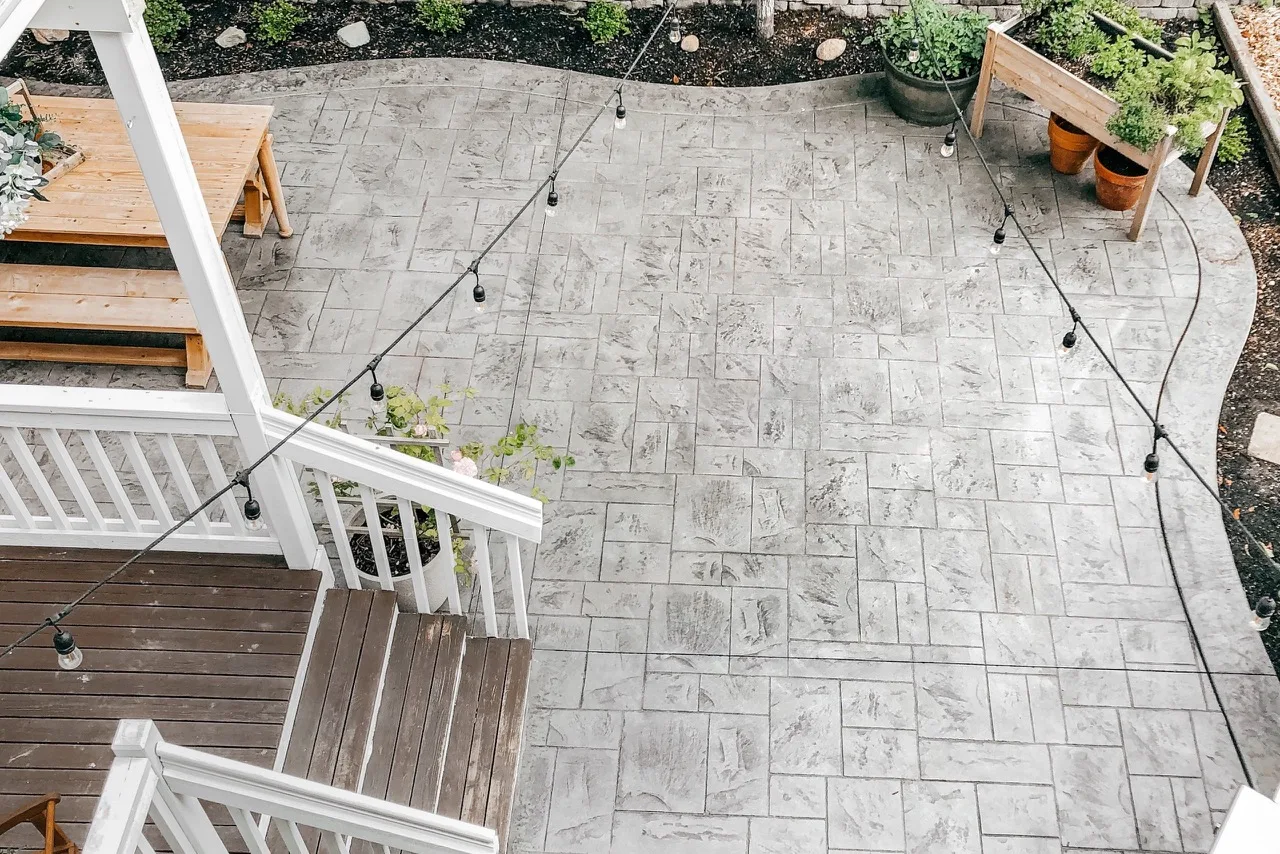
What does stamped concrete cost in Louisiana, and how does it hold up?
Stamped concrete runs $10 to $14 per square foot for a single pattern and color, $14 to $20 for multi-color work with borders, and $20 and up for custom jobs, per 2026 industry pricing. That is about double plain concrete. A 20x20 patio usually lands between $4,000 and $8,000. It holds up for decades in the Gulf South, but only if it gets resealed on schedule, and our humidity changes how that sealing has to be done.
Prices below are published market ranges, not a W2 quote.
What stamped concrete costs per square foot
The pattern and color count set the tier. These are the 2026 national tiers, with plain concrete and pavers for comparison.
| Finish | Installed, per square foot |
|---|---|
| Plain concrete, broom finish | $5–$8 |
| Stamped, one pattern + one color | $10–$14 |
| Stamped, borders + multiple colors | $14–$20 |
| Stamped, high-end custom | $20+ |
| Concrete pavers | $7–$20 |
| Stamped overlay on existing slab | $6–$14 |
A 2022 New Orleans guide put local stamped patios at $8 to $16 per square foot. Treat that as a floor. It is four years old, and current national tiers sit higher.
What a stamped patio project runs
A 20x20 patio is 400 square feet. Across the loaded 2026 sources that lands at $3,200 to $7,200, with one national guide stretching to $11,200 for elaborate work. Tier math says the same thing: $4,000 to $5,600 for one pattern in one color, $5,600 to $8,000 for borders and contrast, and past $8,000 for hand-detailed custom finishes.
Compare that against what plain concrete costs here: the same 400 feet in broom-finish gray runs about $2,000 to $3,200. You are paying roughly double for the look. If you are torn between a stamped patio and a raised wood platform, we build decks too, and the right call usually comes down to your yard’s elevation and drainage.
Which patterns do people pick?
Ashlar slate and cobblestone are the classic picks, and seamless texture skins are now the most popular patio choice in the industry lists. Wood-plank stamps do a convincing boardwalk look. Fans and running-bond brick show up on driveways.
The color usually reads as two tones, and that is mechanical, not paint. A base color goes into the mix or gets floated into the surface. Then a darker release powder does two jobs at once: it keeps the stamp mats from sticking, and the 20 to 30% that stays behind settles into the grooves as the accent. When a quote says “two colors,” that base-plus-release combination is what you are buying.
What are the real downsides?
Repairs are the big one. A slab repair never quite matches a stamped, colored surface, so a bad crack stays visible. Pavers win that comparison, since one damaged unit lifts out and gets replaced.
Resealing is forever. Every 2 to 5 years, at about $1.20 to $1.75 per square foot professionally. Skip it long enough and the finish dulls, stains, and wears.
Sealed concrete gets slick. Glossy sealers are slippery when wet, which matters on a pool deck in a state with 60-plus inches of rain a year. The fix is standard: a non-slip additive broadcast into the sealer coat. Ask for it by name.
And it cracks like any slab if the ground under it moves. The pattern lines hide hairline cracks well, but the cure is the same one we cover in pouring concrete on Louisiana clay: base prep first.
How does it hold up in Louisiana heat and humidity?
Better than the national guides suggest, if you read them carefully. Most stamped-concrete warnings lead with freeze-thaw damage and deicing salts. New Orleans averages about five freezing nights a year, so that failure mode barely applies here. Our climate kills stamped concrete a different way: through the sealer.
A washed-out stamped patio is almost never faded pigment. Integral color does not fade. What breaks down is the acrylic sealer above it, and UV does the breaking. Cheap sealer also yellows in the sun. A reseal restores the color, which is why the 2-to-5-year cadence is the whole maintenance story.
Humidity sets the rules for that resealing. Sealer applied over damp concrete, or within a few degrees of the dew point, traps moisture and turns white or peels. On a Louisiana summer morning the dew point makes that easy to get wrong, so the pros seal in the late afternoon after a dry stretch. Two more Gulf South notes: a high water table can push salts up through colored slabs as white efflorescence blotches, and shaded slabs grow mildew. Clean mildew with a bleach solution, never vinegar, which eats the sealer.
Can you stamp over existing concrete?
Yes, with a stampable overlay: a polymer-modified topping applied 1/4 to 3/4 inch thick, then stamped like fresh concrete. At $6 to $14 per square foot it beats tearing out and repouring a sound slab.
The word that matters is sound. Overlays fail on slabs with large cracks, spalling, or settlement, because the topping cracks right along with the base. Surface prep is the other failure point. The old slab has to be cleaned, repaired, and profiled so the overlay bonds. One regional note: overlays show efflorescence more readily than troweled finishes, so on damp ground the drainage has to be fixed before the overlay goes down.
FAQ
What is the downside of stamped concrete? Four real ones. Repairs are hard to blend, so a bad crack never fully disappears. It needs resealing every 2 to 5 years for life. Glossy sealer gets slippery when wet unless a non-slip additive goes in. And like any slab, it can crack if the base under it was done poorly.
How much does a 20x20 stamped concrete patio cost? A 20x20 patio is 400 square feet. At 2026 rates of $10 to $20 per square foot, most land between $4,000 and $8,000. A single pattern in one color sits at the low end. Borders, contrast colors, and hand-detailed work push past $8,000. Older New Orleans guides start around $4,000.
Is stamped concrete expensive compared to plain concrete or pavers? It runs about double plain concrete: $10 to $14 per square foot for basic stamped work against $5 to $8 for plain. Against pavers it is roughly a wash. Pavers run $7 to $20 installed. Both last 30-plus years with care, and pavers are cheaper to spot-repair later.
Can you put stamped concrete over existing concrete? Yes, if the slab is sound. A stampable overlay goes on 1/4 to 3/4 inch thick and costs about $6 to $14 per square foot, well under tear-out and repour. It only works on concrete without major cracks, spalling, or settlement, and surface prep decides whether it bonds.
How often does stamped concrete need to be resealed in Louisiana? Plan on every 2 to 5 years, and sooner for a patio in full sun or heavy use. Professional resealing runs about $1.20 to $1.75 per square foot, so a 400-square-foot patio costs roughly $500 to $700. Around here the sealer is what fails, so timing matters more than brand.
Get a price for the patio you actually want
Pattern, color count, footage, and what your ground needs underneath decide the real number. W2 Commercial Construction pours stamped and decorative concrete across the Northshore and Greater New Orleans, with the base prep done right for this soil. Ask for a free estimate and we will look at the space, talk through patterns, and give you a written price.