
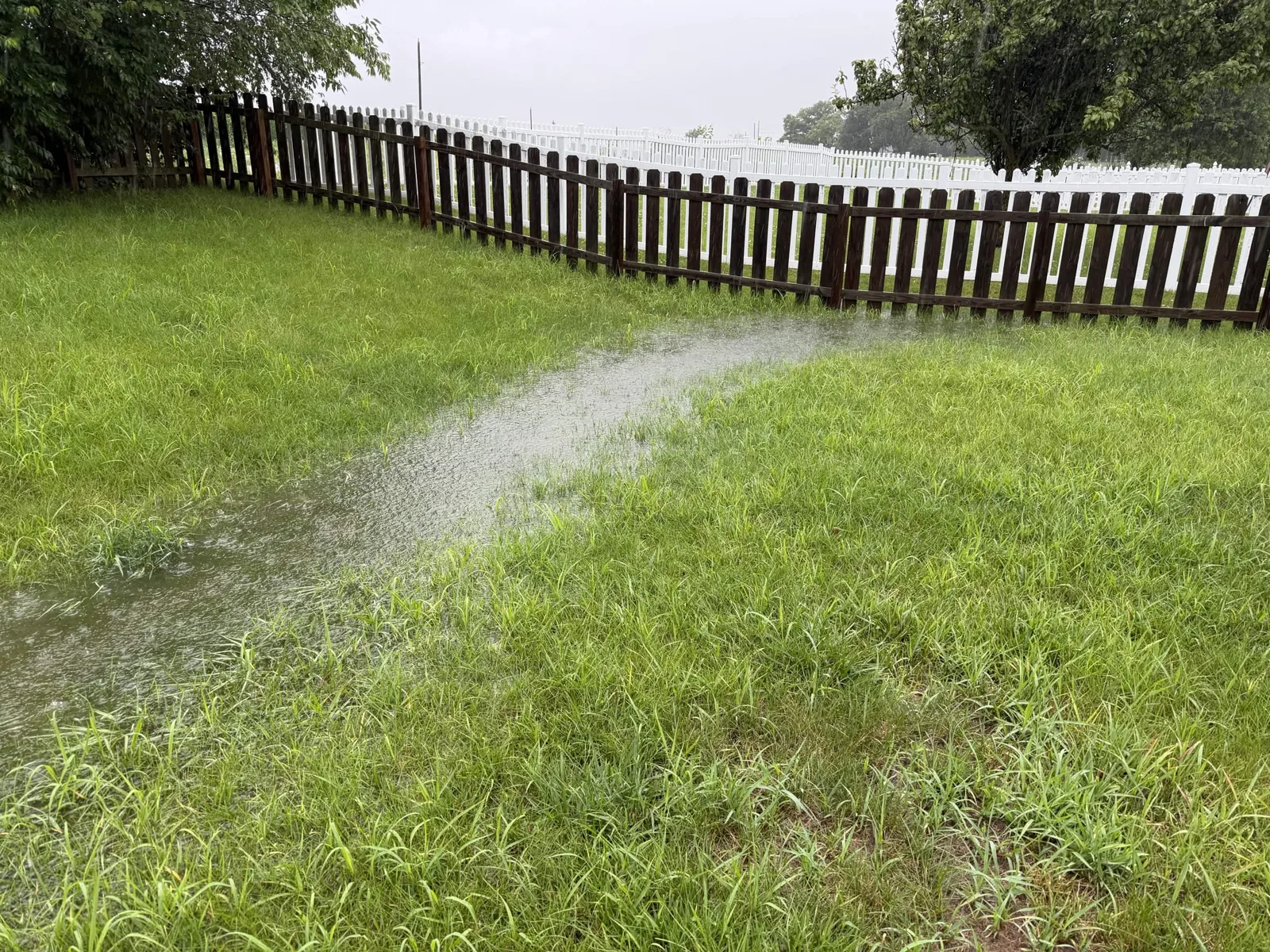
How do you know if your yard has a drainage problem?
Seven signs tell the story: water standing longer than 24 to 48 hours after rain, ground that stays mushy, mosquitoes breeding, white stains on the foundation, erosion channels, patches of dying grass, and moisture under the house. One sign might be a fluke. Two or more mean the yard is holding water it should be shedding, and in Louisiana that costs you more the longer it runs.
Here is each sign, what it means, and the fix that usually matches it.
The 7 signs, and what each one means
| Sign | What it points to | The usual fix |
|---|---|---|
| Standing water 24–48+ hours | Soil or grade cannot move the volume | French drain, regrading |
| Mushy lawn between rains | Saturated subsoil, high water table | French drain |
| Mosquito swarms | Water standing 5+ days somewhere | Eliminate the standing water |
| White stains (efflorescence) on the slab or brick | Water wicking through the foundation | Drainage away from the slab |
| Erosion channels, washed-out mulch | Concentrated surface flow | Regrading, swale, downspout work |
| Dying or yellowing grass patches | Roots drowning in oxygen-starved soil | Grading plus drainage |
| Damp crawl space or slab edge | Water collecting against the house | Perimeter drainage, grade correction |
Standing water is the headline sign
Puddles after a Louisiana downpour are normal. Puddles still there two days later are not. Lawn-care companies and university extension services use the same threshold: water should drain or evaporate within about a day or two. There is even a simple test from Colorado State’s extension service: dig a hole about a foot deep, fill it with water, and watch. If it has not drained in 30 minutes, drainage is poor; if it is still holding water a full day later, the soil is genuinely waterlogged.
St. Tammany Parish takes the mosquito side of this seriously enough that the parish mosquito abatement district runs a standing-water registry and will send a field biologist to inspect, their trigger is water that has not drained in five or more days. If your yard qualifies for a parish mosquito inspection, it qualifies for drainage work.
Why Louisiana yards fail faster than most
Three local facts stack against your lawn. First, the rain: southeast Louisiana averages more than 60 inches a year, among the highest in the country, and the 4-inch-in-a-day storms have been hitting record frequency. The August 2016 event dropped 20 to 30 inches in parts of the state. Second, the ground: flat terrain and clay-heavy, slow-draining soils mean water that lands often has nowhere to go. Third, the houses: with our high water table ruling out basements, nearly everything here sits on a slab, right at ground level, right where the water collects.
That third fact is why drainage is a foundation issue and not just a lawn issue. Research on Louisiana’s expansive soils puts historical property losses around $66 million a year statewide, from clay that swells when wet and shrinks when dry. The same study projects that by 2050, the single worst census block in the state for expansive-soil losses sits in St. Tammany Parish. Uneven moisture around a slab moves the slab unevenly. Standing water against your foundation is the mechanism, and drainage is the cure.
Matching the fix to the sign
The fixes run a ladder from simple to structural, and the right one depends on where your water comes from:
- Downspout extensions when roof water dumps at the slab.
- Regrading when the yard pitches toward the house or holds bowl-shaped low spots. About 6 inches of fall in the first 10 feet away from the house is the standard.
- French drains when the ground itself stays saturated, a gravel-and-pipe trench that intercepts subsurface water and carries it to an outlet.
- Catch basins and area drains when water collects at a predictable low point.
- Swales when sheet flow needs a shaped path across the lot.
- Rain gardens for low spots you would rather plant than pipe, an approach the LSU AgCenter recommends where practical.
Most wet yards here need two fixes working together, grading to handle the surface water and a drain to handle what is in the ground. That pairing is exactly what our sitework and drainage crews build, and because we do our own grading and dirt work, it ships as one scope instead of two contractors and a gap in between. For what the bigger fixes cost, our french drain cost guide has the real numbers.
When to stop watching and call
If you have hit two or more signs on the list, the yard has told you what it needs. The wet season makes it worse: from December through April the water table under much of the Northshore sits within a few feet of the surface, so every rain lands on ground that is already full. A twenty-minute walk of the property tells us where the water starts, where it should exit, and what the fix actually requires. Estimates are free, and a dry yard is a solvable problem.